







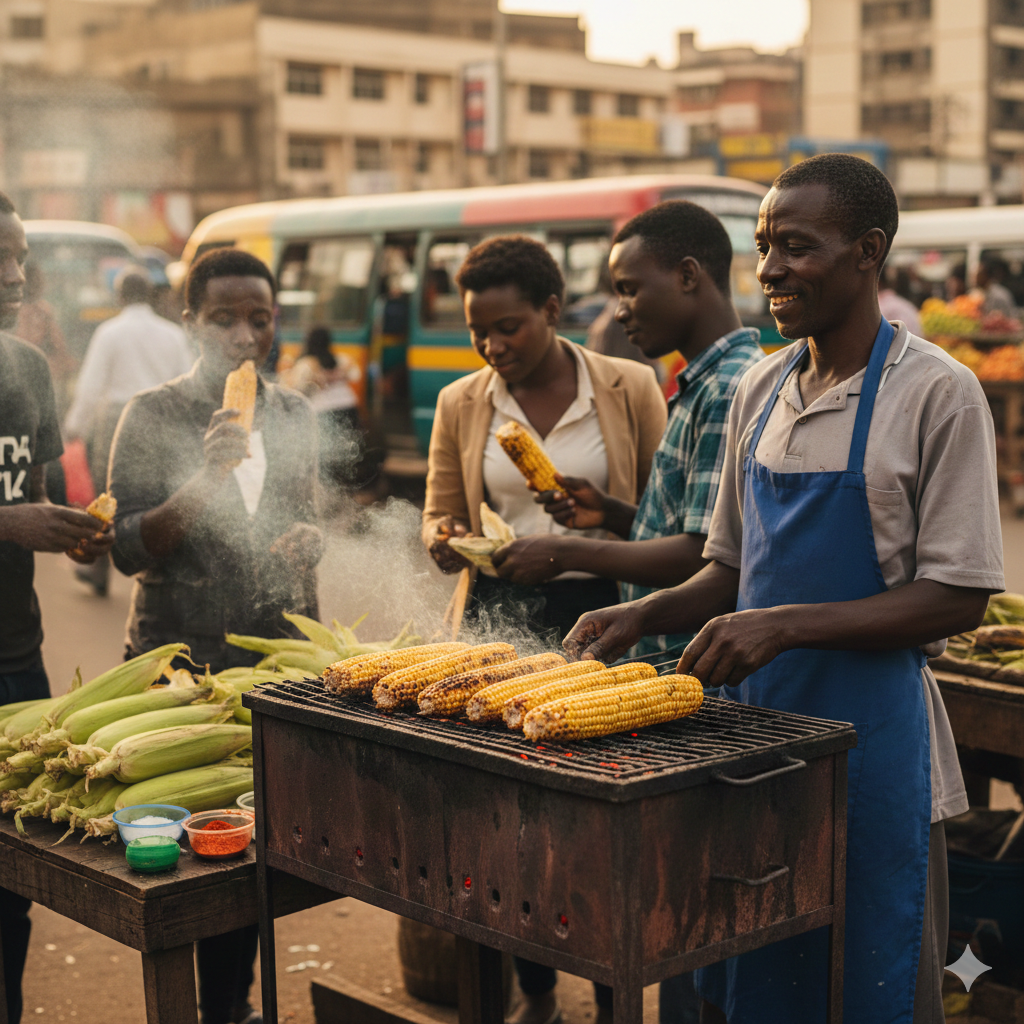
Profitable Mahindi Choma Business in Nairobi: The Ultimate 2026 Guide
Introduction
In the heartbeat of Nairobi—from the busy pavements of Upper Hill to the crowded stages of Embakasi—one scent reigns supreme: Mahindi Choma. While others look for complex tech startups, smart entrepreneurs are looking at the grill. The roasted maize business is a high-yield, recession-proof venture that turns a humble Ksh 15 cob into a Ksh 40 goldmine.
This guide breaks down the “finer details” of the trade, from legal compliance to the secret of the perfect lemon-chili rub.
1. The Financial Blueprint: Real-World Margins
Street food is a volume game. Here is how the math actually works when you factor in the “hidden” costs like transport and waste.
The Unit Economics
| Item | Cost (Ksh) |
| Buying Price (Wholesale) | Ksh 15 |
| Charcoal & Salt/Chili per cob | Ksh 4 |
| Transport & Labor per cob | Ksh 1 |
| Total Landed Cost | Ksh 20 |
| Selling Price | Ksh 40 |
| Net Profit per Cob | Ksh 20 |
The Monthly Potential
If you move 250 cobs a day (typical for a high-traffic matatu stage):
- Daily Net Profit: Ksh 5,000
- Monthly Net Profit (26 Days): Ksh 130,000
- Note: This is higher than many entry-level corporate jobs in Nairobi.
2. Regulatory Compliance: Staying “Kanjo-Proof”
Operating on the streets of Nairobi requires more than just a grill; it requires legitimacy. To avoid having your equipment confiscated by Nairobi City County (NCC) officials, you need these four pillars:
A. The Unified Business Permit (UBP)
Nairobi has consolidated permits. You no longer need five different pieces of paper. Visit the Nairobi Services Portal to apply for a small informal trader’s license.
- Cost: Ksh 5,000 – Ksh 10,000 per year depending on your ward.
B. Public Health Requirements
Since you are handling food, the Public Health Act is strict:
- Food Handler’s Certificate: You must undergo a medical exam (tests for TB, Typhoid, and Salmonellosis) at a county facility like Lady Northey or STC Casino. Cost: Ksh 1,000 – 2,000 (Valid for 6 months).
- Food Hygiene License: This certifies your “premises” (even if it’s a mobile stand) meets basic cleanliness standards.
C. Environmental & Fire Safety
- NEMA Compliance: If using charcoal, ensure you have a steady supplier who can prove the charcoal is legally sourced (Forestry Act).
- Fire Safety: A simple 2kg dry powder fire extinguisher or a clearly marked bucket of dry sand is required for any business involving open flames.
3. Strategic Location: Where the Money Sits
A jiko in the wrong place is just a heater. You need “Transit Points.”
- Matatu Terminals: People are hungry while waiting for buses (e.g., Kencom, Khoja, Muthurwa).
- Construction Sites (Mjengo): Workers need heavy, cheap snacks at midday.
- Evening Routes: Position yourself on the “left side” of the road leading into estates. People buy snacks on their way home, rarely on their way to work.
4. The “Finer Details” of Operations
Sourcing the Best Maize
Don’t just buy any maize. Look for “Green Maize.” * The Variety: Hybrid 614 is popular, but local varieties from Narok or Loitokitok are often sweeter.
- The Test: Press a kernel with your fingernail. If a milky liquid squirts out, it’s perfect. If it’s hard, it’s “maganda” (dry) and will be tough to chew, ruining your reputation.
The Secret Sauce (The Rub)
Your profit is in the seasoning.
- The Mix: Fine salt blended with high-quality chili powder (Ksh 100 per 250g pack).
- The Application: Use a fresh lemon half to rub the mixture onto the hot cob. The acidity of the lemon enhances the sweetness of the charred corn.
Equipment Maintenance
A standard Mahindi Jiko costs roughly Ksh 17,000.
- Lining: Line the inner base with fireclay (clay mixed with ash) to retain heat and save on charcoal.
- The Grill: Ensure the wire mesh is stainless steel to prevent rust flakes from sticking to the food.
5. Risk Management
- Weather: Have a large, sturdy umbrella (branded ones from telcos are cheaper) to protect your fire from Nairobi’s sudden rains.
- Waste: Have a bin for the husks. Leaving husks on the ground is an invitation for a “littering fine” from the county.
Final Verdict
The Mahindi Choma business is a “low entry, high exit” venture. With a startup capital of Ksh 35,000 (covering equipment, stock, and all permits), you can be fully operational and profitable within your first 10 days.
🚀 The Mahindi Choma Founder’s Checklist
Phase 1: Market Research & Sourcing
- [ ] Identify your “Transit Point”: Scout 3 locations. Stand there for 1 hour at 5:00 PM and count how many people walk past.
- [ ] Locate a Wholesale Supplier: Visit Marikiti or Muthurwa Market at 5:00 AM to identify reliable maize truck drivers or wholesalers.
- [ ] Charcoal Supply: Find a licensed local vendor who can deliver in bulk (buying by the sack is 30% cheaper than by the tin).
- [ ] Variety Check: Ensure you can consistently source “Green Maize” (H614 or similar milky varieties).
Phase 2: Equipment & Setup
- [ ] Fabricate/Purchase Jiko: Ensure it has a deep ash pit and a sturdy mesh.
- [ ] The “Secret Sauce” Kit:
- [ ] High-grade chili powder.
- [ ] Fine table salt.
- [ ] Plastic airtight containers for mixing.
- [ ] A small bucket for fresh lemons.
- [ ] Operational Tools:
- [ ] Long-handled tongs (to save your hands from the heat).
- [ ] Sharp knife (for trimming husks).
- [ ] Wire brush (for cleaning the grill daily).
- [ ] Weather Proofing: Purchase a heavy-duty 3-meter garden umbrella and a sturdy base.
Phase 3: The “Paperwork” (Nairobi Compliance)
- [ ] Medical Examination: Visit a County Clinic for blood/stool tests.
- [ ] Food Handler’s Certificate: Obtained once medical results are clear (Ksh 1,000 – 2,000).
- [ ] Unified Business Permit: Apply via the Nairobi City County self-service portal (choose “Small Informal Trader”).
- [ ] Fire Safety: Purchase a 2kg dry powder extinguisher or a dedicated fire bucket with sand.
- [ ] Branding: (Optional but recommended) Paint your name or “Mahindi Tamu” on your jiko stand to build customer loyalty.
Phase 4: Launch Day Operations
- [ ] Waste Management: Set up a gunny bag (shaka) or bin specifically for maize husks to avoid littering fines.
- [ ] Cash Management: Prepare “change” (float) in Ksh 50 and Ksh 20 denominations.
- [ ] First Batch: Start roasting 30 minutes before the evening rush (around 4:30 PM) so the aroma is already in the air when people arrive.
Summary Table: Estimated Startup Cost
| Category | Item | Budget (Ksh) |
| Hardware | Jiko, Umbrella, Stool | 18,000 |
| Legal | Permits & Health Certs | 8,000 |
| Stock | First 2 Sacks + Charcoal | 5,000 |
| Total | 31,000 |
Inventory Track Records
Daily Inventory & Profit Log
(Use this table to track your daily performance and optimize your stock)
| Date | |
| Starting Stock (Total Cobs) | |
| Closing Stock (Unsold Cobs) | |
| Total Cobs Sold | |
| Cobs Wasted/Spoilt | |
| Charcoal Used (Tins/Sacks) | |
| Daily Gross Income (Ksh) | |
| Daily Expenses (Ksh) | |
| NET DAILY PROFIT (Ksh) |