


KEY INQUIRY QUESTION
Singapore Built Skyscrapers with No Land — Why Are We Satisfied with Unga Packets and Brown Parcels?
When a leader consistently prioritizes spending large amounts of public money on lavish gifts, ceremonies, handouts, or prestige projects—while systematically underinvesting in technology, agricultural modernization, infrastructure, or other productive sectors—it almost always indicates one or more of the following political and governance realities:
1. Clientelism / Patronage-Based Rule
The leader is deliberately buying personal loyalty instead of building institutional strength. Gifts (cash handouts, cars to chiefs or pastors, food packages, branded wrappers, etc.) create direct, personal dependence on the leader rather than on the state. This is cheaper and faster than building a modern economy, and it keeps power centralized in the leader’s hands.
2. Short-Term Political Survival Strategy
The leader (or regime) perceives their hold on power as fragile. Investments in agriculture or technology:
- Take years to show results
- Benefit broad, anonymous populations
- Create independent economic actors (farmers with tractors, tech entrepreneurs, educated youth) who may later demand rights or challenge the regime
Gifts, on the other hand, produce immediate gratitude and visible political rallies, which are useful when the next election (or coup threat) is always around the corner.
3. Weak or Non-Existent Long-Term Vision
The leadership either lacks the competence to design and execute complex productive investments, or simply does not believe they will still be in power when those investments mature, or both. This is extremely common in personalistic, neo-patrimonial, or authoritarian-leaning regimes.
4. Extraction Over Development
The primary goal of the state has shifted from development to extraction. Resources are being redirected toward maintaining a narrow winning coalition (loyalists, security forces, ethnic base, cronies). Gifts are a low-risk way to distribute just enough spoils to keep that coalition happy without creating rival power centres that come with real economic modernization.
5. Signalling Insecurity Rather Than Confidence
Confident, institutionalized regimes invest in productive capacity because they expect to reap the political benefits later. Heavy reliance on gifts is often a sign of underlying anxiety—about elections, elite defections, youth unrest, or military loyalty.
Real-World Patterns
This behaviour is repeatedly observed in:
- Many sub-Saharan African personalistic regimes (e.g., Cameroon under Biya, Uganda under Museveni in later decades, Zimbabwe under Mnangagwa)
- Parts of Central Asia (e.g., Tajikistan, Turkmenistan under Berdimuhamedov’s cult-of-personality spending)
- Some Latin American populist governments during their decline phase (Venezuela under Maduro shifted heavily to CLAP food boxes rather than oil-sector reinvestment)
- Fragile Pacific and Caribbean micro-states
Compare to developmental states like Singapore
A developmental state like Singapore represents almost the exact opposite political and governance logic from a leader who consistently spends on gifts rather than technology or agriculture.Here is a systematic side-by-side comparison:
| Dimension | Gift-Centric / Patronage Regime | Developmental State (Singapore model) |
|---|---|---|
| Core objective of the state | Keep the leader/regime in power today | Build a rich, resilient nation that stays in the global top tier forever |
| Time horizon | Short (next election, next coup threat) | Extremely long (50–100 years) |
| Main tool of legitimacy | Personal generosity, handouts, loyalty bought with gifts | Performance legitimacy: jobs, housing, education, safety, world-class infrastructure |
| Budget priority | Cash transfers, food packages, cars to chiefs, branded T-shirts, stadium rallies, presidential jets | R&D, education, ports, airports, water technology, semiconductor fabs, sovereign wealth funds, agricultural R&D (even with no land) |
| How citizens relate to the state | As clients of the Big Man | As stakeholders in a national success |
| Typical public spending pattern | High on “social assistance” that is politically targeted and often delivered in person by the leader | High on productive investment (Singapore’s gross fixed capital formation has often exceeded 30–40% of GDP for decades) |
| Attitude toward independent economic power | Threatening (farmers with their own tractors, tech entrepreneurs, educated youth can demand rights) | Encouraged (the state deliberately creates millionaires and global companies as long as they remain politically loyal or neutral) |
| Corruption style | Centralized at the top, used to fund patronage networks | Ruthlessly suppressed (and famously) suppressed. Corrupt officials are jailed even if they are from the ruling party |
| Succession mechanism | Often chaotic, violent, or hereditary | Institutionalized, meritocratic, planned years in advance |
| Agricultural policy example | Import food, then distribute it as political gifts during campaigns | No land → invent high-tech agro-science (sky farms, LED vertical farming, fish farms in the ocean) to reach 30% food self-sufficiency target |
| Technology policy example | Import finished gadgets, give them out at rallies | Deliberately build entire industries (semiconductors, biotech, refineries, fintech) from zero, using state-linked companies and sovereign funds |
| Savings & reserves | Leader’s family and cronies stash money abroad; national reserves often raided | Among the highest national savings rates in the world; reserves so large the number is a state secret |
| When the leader dies/retires | Economy often collapses or enters crisis (Zaire→DRC, Venezuela, Turkmenistan after Niyazov) | Seamless transition; economy continues growing (Lee Kuan Yew → Goh Chok Tong → Lee Hsien Loong → Lawrence Wong) |
| Political science classification | Neo-patrimonial, personalistic, or competitive authoritarian | Developmental state / dominant-party technocratic system |
Are We Selling Kenya’s Tomorrow for Today’s Handouts?
How President Ruto’s Patronage Model is Killing Kenya’s Economic Pillars
| Economic Pillar | How Ruto’s Handout Model is Destroying It | Real Evidence (2022–2025) | Long-Term Cost to Kenya |
|---|---|---|---|
| Business & Investment | Punitive taxes to fund deficits caused by populist spending; policy flip-flops | GDP growth fell to 4.9%, NSE lost Sh610B, foreign investors fleeing | Permanent loss of investor confidence, 2–2.8% GDP lost yearly |
| Education | Capitation slashed, HELB starved, universities in chaos to free money for political projects | Secondary funding down to Sh17K/student; 160,000+ students unfunded | A lost generation; Vision 2040 human capital destroyed |
| Health | Rushed, underfunded SHA rollout; hospitals turning away patients to protect patronage budgets | Only a tiny fraction actually contribute; facilities crippled by debt | Millions still uninsured; preventable deaths rising |
| Agriculture | Subsidies used as short-term vote bait instead of irrigation, storage, or climate resilience | 2.6M livestock dead, food imports up 5.8%, only 2% of land irrigated | 40–45% crop yield drop projected by 2050; permanent food insecurity |
| Manufacturing | No industrial policy; funds diverted to wheelbarrows and Hustler Fund optics | Still <10% of GDP; exports <20% of GDP; AfCFTA promises forgotten | 85% of Kenyans trapped in informal jobs forever |
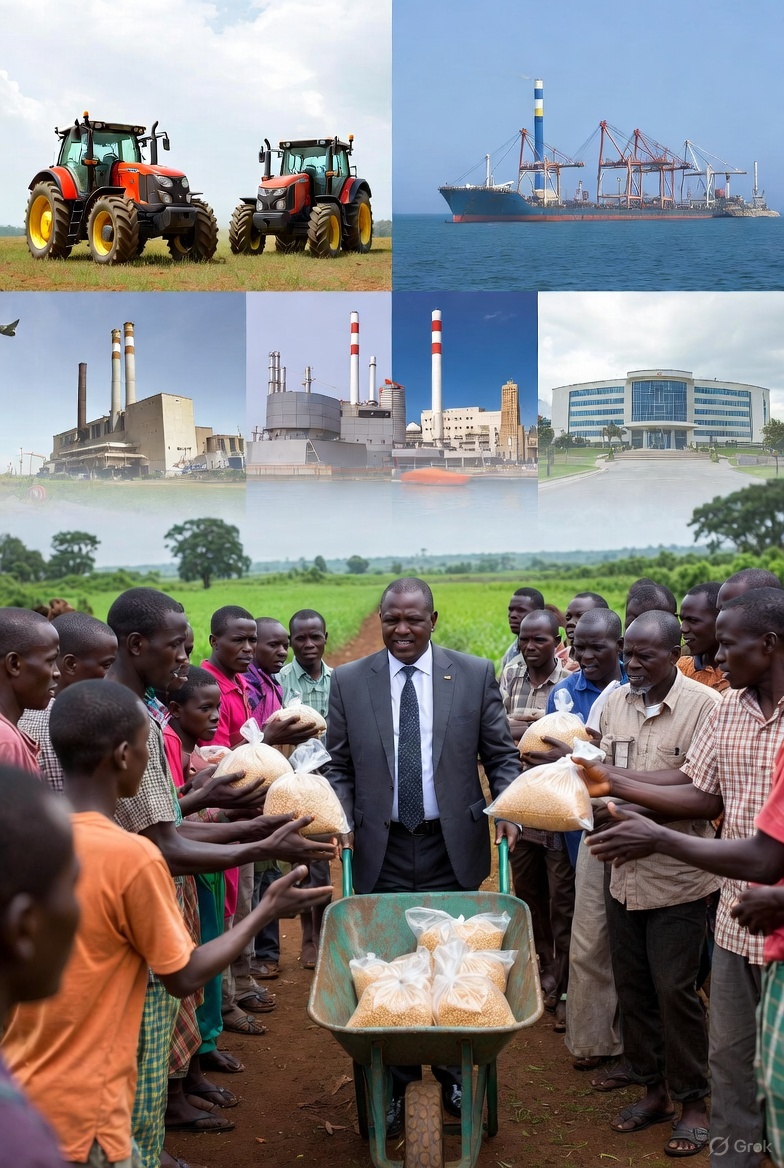
Kenya is being bought—one handout at a time.
Singapore had no land yet built skyscrapers and laboratories.
We have fertile land, brilliant youth, and Indian Ocean ports—yet we celebrate bags of unga and wheelbarrows.
Wake up, Kenya. Demand tractors, factories, and universities—not patronage.
In one sentence:
The gift-centric leader treats the national budget as his personal war chest to buy today’s loyalty.
Singapore’s leaders treated (and still treat) the national budget as seed capital to buy the country an unbeatable future.
That is why, 60 years after independence, Singapore has zero natural resources yet a GDP per capita of ~$91,000 (2025), while many resource-rich gift-centric countries are still stuck below $2,000–$4,000 despite decades of aid, oil, or minerals.
The difference is not resources; it is the choice between patronage and development.
Bottom Line
Consistent, large-scale investment in gifts over productive sectors is one of the strongest empirical indicators political scientists and economists use to classify a regime as neo-patrimonial, personalistic, or competitively authoritarian rather than developmental or programmatic. It is almost never a sign of strength, competence, or genuine concern for long-term national welfare—it is a survival strategy that trades the country’s future for the leader’s present.
In short: when gifts chronically crowd out tractors, irrigation systems, and laboratories, the leader is governing as a patron, not as a statesman.