








Revolutionizing Education: Understanding Kenya’s New KJSEA Grading System
Kenya has taken a bold step forward in educational reform with the introduction of the Competency-Based Curriculum (CBC). This transformative approach shifts the focus from rote memorization and high-stakes exams to holistic skill development and practical competencies. At the heart of this change is the Kenya Junior Secondary Education Assessment (KJSEA), which replaced the long-standing Kenya Certificate of Primary Education (KCPE) in 2025.
For the first time, over 1.1 million Grade 9 students received their results under this new framework, marking a departure from numerical scores and rankings toward a more descriptive, student-centered evaluation system.
Whether you’re a parent, educator, or curious observer, you might be wondering: What does this grading scale really mean? How does it work, and why was it implemented? This post explores the intricacies of the KJSEA grading system, breaking it down category by category and examining its broader implications for Kenya’s future generations.
The Shift from Numbers to Descriptions
Gone are the days of the traditional 8-4-4 system’s raw marks out of 500, where a single point could determine a student’s entire future. The KJSEA adopts a qualitative, descriptive grading scale designed to provide a more nuanced view of a learner’s abilities. This system emphasizes progress, strengths, and areas for improvement rather than pitting students against one another in a zero-sum ranking game.
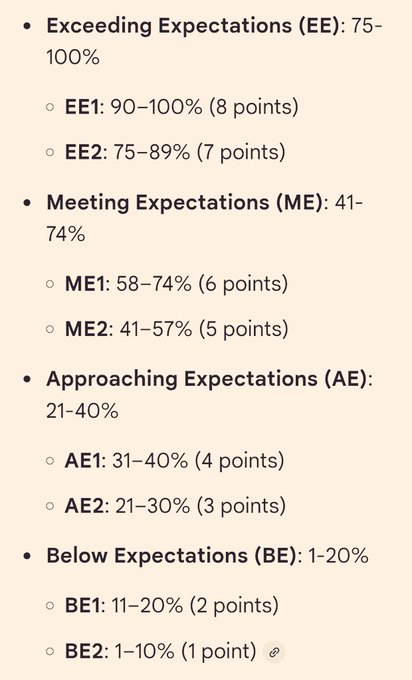
The scale is divided into four main performance bands: Exceeding Expectations (EE), Meeting Expectations (ME), Approaching Expectations (AE), and Below Expectations (BE). Each band is further subdivided into levels, with associated percentage ranges and point values from 1 to 8. These points serve as a subtle quantitative layer to aid in school placements without overshadowing the descriptive focus.
This structure aims to reduce the intense pressure and mental health challenges associated with the old exam system. By using broad descriptors, it encourages a growth mindset, where students are seen as works in progress rather than fixed entities defined by a score.
Breaking Down the Performance Bands
Exceeding Expectations (EE): 75-100%
This top tier celebrates students who not only grasp core competencies but demonstrate exceptional application, creativity, and depth.
- EE1: 90-100% (8 points) – Reserved for those who achieve near-perfect mastery. Students here exhibit advanced problem-solving, innovative thinking, and the ability to integrate knowledge across subjects seamlessly.
- EE2: 75-89% (7 points) – Indicates strong performance with room for greater refinement. These students consistently outperform expectations, perhaps leading group projects or excelling in practical assessments.
Reaching EE levels is a testament to a student’s dedication and the effectiveness of CBC’s hands-on learning approach.
Meeting Expectations (ME): 41-74%
This band represents a balanced, expected level of achievement. It affirms that the learner has met the curriculum’s core requirements, demonstrating reliable knowledge and skills.
- ME1: 58-74% (6 points) – Highlights consistent competence, where students apply concepts effectively in various contexts.
- ME2: 41-57% (5 points) – Shows foundational achievement with steady progress toward full proficiency. Students grasp essentials but may benefit from targeted support to advance further.
ME emphasizes that meeting standards is a success in itself, aligning with CBC’s goal of preparing well-rounded citizens.
Approaching Expectations (AE): 21-40%
This band is for students building toward full competence. It’s a positive acknowledgment of effort and potential, not a failure label.
- AE1: 31-40% (4 points) – Learners are close to meeting expectations, perhaps needing just a bit more practice or guidance.
- AE2: 21-30% (3 points) – Indicates emerging understanding, where basics are in place but deeper application is developing.
AE’s descriptive nature helps destigmatize lower performance, framing it as a stepping stone rather than a setback.
Below Expectations (BE): 1-20%
This band identifies areas where significant support is needed. It’s not punitive but diagnostic, highlighting where interventions can make the biggest difference.
- BE1: 11-20% (2 points) – Students show some foundational elements but struggle with consistent application. This could stem from various factors, like learning challenges or resource gaps.
- BE2: 1-10% (1 point) – Points to minimal achievement, urging immediate, tailored assistance to build basics.
By using points sparingly (only 1-8 across the scale), the system minimizes competition while providing a mechanism for secondary school admissions.
Why This System? Key Benefits
The KJSEA grading scale is rooted in educational psychology and global best practices. The old KCPE’s numerical rankings often led to anxiety, cheating scandals, and a narrow focus on test preparation, sidelining creativity and life skills. In contrast, CBC and KJSEA prioritize competencies like communication, digital literacy, and environmental awareness.
Key benefits include:
- Reduced Stress: Without direct comparisons, students can focus on personal growth
- Holistic Evaluation: Assessments incorporate projects, portfolios, and observations, not just written exams
- Equity and Inclusion: Accommodates diverse learning styles, benefiting students in underserved areas
- Better Feedback: Descriptive reports guide parents and teachers on specific improvements, fostering collaborative support
Early feedback from the 2025 results rollout shows mixed reactions—some parents miss the clarity of numbers, while educators praise the shift toward meaningful learning.
Challenges and the Road Ahead
No change comes without hurdles. Cultural attachment to quantifiable metrics has sparked confusion, with some calling for hybrid models. School placements, traditionally based on scores, now use points alongside other factors, potentially leading to initial adjustments. However, with ongoing teacher training and public awareness campaigns, these challenges can be addressed.
The KJSEA represents Kenya’s commitment to 21st-century education. By 2030, as the first CBC cohort graduates, we may see a more innovative, resilient workforce emerging.
Final Thoughts
The KJSEA grading system is more than a scale—it’s a philosophy that values every student’s journey. As Kenya adapts to this new framework, the focus remains on nurturing competent, confident learners ready to thrive in a rapidly changing world.
What are your thoughts on this new approach? Share your perspective in the comments below!