









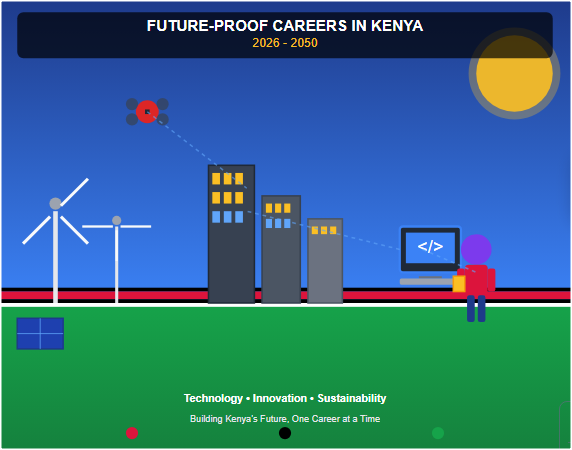
Future-Proof Your Career: The Top 10 Most Promising Careers in Kenya (2026-2050)
The job market our children will enter looks nothing like the one we know today. As Kenya pushes toward industrialisation, digital transformation, and sustainable development, the careers that will define success are rapidly evolving. For Form Four students choosing university courses and parents guiding these critical decisions, understanding these shifts is no longer optional—it’s essential.
This guide explores the most promising careers from 2026 to 2050, grounded in Kenya’s Vision 2030, the Bottom-Up Economic Transformation Agenda (BETA), and our emerging role as East Africa’s innovation hub.
The Top 10 Most Promising Careers in Kenya (2026-2050)
1. Renewable Energy Engineer & Technician
Why it matters in Kenya: We’re already the world’s largest geothermal power producer per capita, with Olkaria leading the way. With the government targeting 100% clean energy by 2030 and massive solar and wind projects in Turkana and Garissa, this sector needs thousands of engineers and technicians.
Real opportunities: Kenya Power, KenGen, private IPPs (Independent Power Producers), solar installation companies like M-KOPA, and rural electrification programs.
What to study:
- High School: Physics, Mathematics, Chemistry (STEM cluster)
- University: Electrical Engineering (Power Systems), Mechanical Engineering, Renewable Energy Technology at institutions like University of Nairobi, JKUAT, or Technical Universities
- Alternative paths: Diploma in Electrical Installation from Kenya Power Training School, TVET courses in solar installation
Expected salary range: KSh 80,000 – KSh 300,000 monthly (depending on experience and specialization)
2. Data Scientist & AI Specialist
Why it matters in Kenya: From Safaricom analyzing M-Pesa transactions to banks detecting fraud, every sector needs professionals who can turn data into decisions. The government’s Digital Superhighway program and Konza Technopolis will create thousands of jobs.
Real opportunities: Banks (Equity, KCB), telcos (Safaricom, Airtel), tech startups, research institutions, and government analytics departments.
What to study:
- High School: Mathematics (must be strong), Computer Studies, Physics
- University: Data Science, Computer Science, Statistics, Actuarial Science, Mathematics
- Self-learning: Python, R programming, SQL—plenty of free resources like Data Science Dojo Kenya
Expected salary range: KSh 100,000 – KSh 400,000 monthly
3. Software Developer (FinTech & AgriTech Focus)
Why it matters in Kenya: Kenya is Africa’s Silicon Savannah. The success of M-Pesa, Twiga Foods, and Sendy proves our innovative edge. As more businesses digitize and the government pushes e-government services, developers are gold.
Real opportunities: Safaricom, startups in iHub and Nailab, international remote work (earning in dollars), freelancing, or starting your own tech company.
What to study:
- High School: Mathematics, Computer Studies, Physics (though passion matters more than grades here)
- University: Computer Science, Software Engineering, IT
- Faster routes: Moringa School, ALX Africa, Power Learn Project—intensive bootcamps producing job-ready developers in months
Expected salary range: KSh 80,000 – KSh 500,000+ monthly (senior developers and those working remotely earn significantly more)
4. Digital Marketing & E-Commerce Specialist
Why it matters in Kenya: During COVID-19, we saw businesses shift online overnight. From mama mbogas selling on WhatsApp to Jumia and Kilimall expanding, e-commerce is exploding. Brands need experts to manage social media, run ads, and drive online sales.
Real opportunities: Marketing agencies, corporate companies, NGOs, personal consulting, or running your own e-commerce store.
What to study:
- High School: Business Studies, Mathematics, English, CRE/IRE (communication skills matter)
- University: Marketing, Communication, Business Administration
- Practical skills: Google Digital Skills, Facebook Blueprint, SEO courses—certifications are often more valuable than degrees here
Expected salary range: KSh 50,000 – KSh 250,000 monthly (freelancers can earn more)
5. Climate Change & Environmental Consultant
Why it matters in Kenya: Droughts in the North, floods in Western Kenya, unpredictable farming seasons—climate change is our reality. Companies now need environmental audits, carbon offset programs, and sustainability strategies to comply with regulations and access international markets.
Real opportunities: NEMA, county governments, NGOs (UNDP, WWF), multinational corporations, consultancy firms.
What to study:
- High School: Geography, Biology, Chemistry
- University: Environmental Science, Climate Change & Development, Agriculture, Natural Resource Management
- Add-ons: Project management certifications, GIS (Geographic Information Systems)
Expected salary range: KSh 70,000 – KSh 300,000 monthly
6. Cybersecurity Analyst
Why it matters in Kenya: Remember the massive bank heists via hacked systems? As Kenya goes cashless and government services move online (eCitizen, iTax), protecting digital infrastructure is critical. There’s a severe shortage of cybersecurity experts.
Real opportunities: Banks, telcos, government (Communications Authority of Kenya), private cybersecurity firms, international remote roles.
What to study:
- High School: Mathematics, Computer Studies, Physics
- University: Cybersecurity, Computer Science, Information Technology
- Certifications: CompTIA Security+, Certified Ethical Hacker (CEH), CISSP—these matter more than the degree
Expected salary range: KSh 120,000 – KSh 450,000 monthly
7. Healthcare Professional (Telemedicine & Health Tech)
Why it matters in Kenya: With a doctor-to-patient ratio of 1:16,000 (far below WHO recommendations), telemedicine platforms like Ilara Health and mHealth Kenya are bridging the gap. We need doctors, nurses, and clinical officers comfortable with digital tools, plus engineers building health tech solutions.
Real opportunities: Public hospitals, private clinics, telemedicine startups, medical device companies, pharmaceutical companies, NGOs.
What to study:
- High School: Biology, Chemistry, Physics, Mathematics (for medicine/nursing)
- University: Medicine, Nursing, Clinical Medicine, Pharmacy, Biomedical Engineering
- Tech side: Computer Science with health informatics focus
Expected salary range: KSh 80,000 – KSh 500,000+ monthly (doctors and specialists)
8. Urban Planner & Infrastructure Developer
Why it matters in Kenya: Nairobi’s population will hit 10 million by 2030. Kisumu, Mombasa, Eldoret, Nakuru—all our cities are bursting. We need professionals who can design organized, sustainable urban spaces with proper roads, housing, waste management, and water systems.
Real opportunities: Ministry of Transport, county governments, real estate developers, international firms (AECOM, Bechtel), consultancy firms.
What to study:
- High School: Geography, Mathematics, Physics, Art & Design
- University: Urban Planning, Architecture, Civil Engineering, Quantity Surveying
- Best schools: University of Nairobi’s Department of Urban & Regional Planning, JKUAT
Expected salary range: KSh 80,000 – KSh 350,000 monthly
9. Mechatronics & Automation Engineer
Why it matters in Kenya: For Kenya to industrialize (a key Vision 2030 goal), our factories must become more efficient. Companies like Bidco, Brookside, and manufacturing hubs in Athi River need engineers who can install and maintain automated systems and robotics.
Real opportunities: Manufacturing companies, KenGen, Kenya Railways, automotive industry, tech startups building robotics solutions.
What to study:
- High School: Physics, Mathematics, Chemistry/Computer Studies
- University: Mechatronics Engineering, Electrical & Electronics Engineering, Mechanical Engineering
- Top schools: JKUAT, Technical University of Kenya, Moi University
Expected salary range: KSh 100,000 – KSh 350,000 monthly
10. Creative Content Producer (Animation, Gaming, Digital Media)
Why it matters in Kenya: Kenya’s creative industry contributes over KSh 200 billion to GDP. From Sauti Sol to Lupita Nyong’o, we have global talent. Now, with streaming platforms and social media, animators, game developers, podcasters, and video producers can reach worldwide audiences from Nairobi.
Real opportunities: Production houses, advertising agencies, YouTube/TikTok content creation, game development studios, international freelancing (Upwork, Fiverr).
What to study:
- High School: Art & Design, English, Computer Studies
- University: Film & Animation, Graphic Design, Multimedia
- Practical route: Buni Media Lab, Zawadie Academy, online courses (Udemy, Skillshare)—portfolio matters more than certificates
Expected salary range: KSh 40,000 – KSh 300,000+ monthly (top creators and freelancers earn much more)
How Kenyan Students Can Position Themselves for Success
1. Take KCSE Subject Choices Seriously
Your Form One subject selection determines which university courses you can pursue. For most future-proof careers, you need:
- STEM subjects: Mathematics, Physics, Chemistry, Computer Studies
- Communication skills: Strong English and Kiswahili
- For business careers: Business Studies, Mathematics
Aim for at least a B plain in KCSE to access most competitive degree programs.
2. Don’t Overlook TVET and Technical Training
University isn’t the only path. Technical and Vocational Education Training (TVET) institutions produce job-ready graduates. Courses in solar installation, software development, digital marketing, or mechatronics from Kenya National Polytechnic, KMTC, or regional technical institutes often lead to faster employment.
The government is also pushing the TVET route with Competency-Based Education and Training (CBET).
3. Learn Digital Skills Early
While still in school:
- Take free online courses (Google Digital Skills, Microsoft Learn, Khan Academy)
- Learn to code (Scratch, Python basics) using platforms like Codeacademy
- Start a small online business or blog
- Get comfortable with Microsoft Office, Google Workspace
These give you a competitive edge before university.
4. Gain Practical Experience
Kenyan employers value experience over just grades. While in university:
- Internships: Apply aggressively to companies, even for unpaid positions initially. Organizations like AIESEC Kenya, Internship Kenya, and Kuhustle connect students to opportunities.
- Attachments: Industrial attachment is mandatory for most courses—take it seriously.
- Side hustles: Freelance, tutor, create content, start small projects. This builds your CV.
5. Network and Mentor
Join professional associations early:
- Engineering Board of Kenya (EBK) for engineers
- Institute of Certified Public Accountants of Kenya (ICPAK) for finance
- Marketing Society of Kenya (MSK)
- Tech communities: iHub, Nailab, Google Developer Groups
Attend career fairs, webinars, and connect with professionals on LinkedIn. In Kenya, “who you know” still matters.
6. Consider Cost and Scholarships
University is expensive. Explore:
- Government sponsorship: HELB (Higher Education Loans Board)
- County scholarships: Many counties sponsor bright students
- Private scholarships: Equity Wings to Fly, KCB Foundation, Safaricom Foundation
- Affordable quality: Consider technical universities, which are cheaper than top-tier universities but offer solid programs
7. Stay Adaptable
The career you train for may evolve dramatically. For instance, accountants now need data analytics skills; journalists need video editing. Commit to lifelong learning through online courses, professional certifications, and staying curious.
Special Considerations for Kenyan Parents
- Don’t force “safe” careers: Medicine, law, and engineering are prestigious but not the only paths to success. Support your child’s strengths and interests.
- Understand the market: A degree isn’t a job guarantee. Skills, networks, and hustle matter just as much.
- Invest in their digital tools: A laptop and internet access are as essential as textbooks now.
- Encourage entrepreneurship: Many of Kenya’s wealthiest didn’t follow traditional paths. Support your child’s business ideas.
The Bottom Line
Kenya’s future is bright, but success belongs to the prepared. The days of “study hard, get a degree, get a government job” are over. Today’s winners will be those who combine solid education with digital skills, practical experience, and an entrepreneurial mindset.
Whether your child becomes a renewable energy engineer powering rural Kenya, a developer creating the next M-Pesa, or a content creator telling Kenyan stories to the world, one thing is clear: the future of work is already here, and it’s time to prepare.
Which career path excites you most? What challenges do you see? Share your thoughts below!